
In partnership with

Welcome back to the Launch Key 🚀
As if the AI story couldn’t get any faster, last week’s Fable 5 release reshaped how people think about AI agents. The /loop functionality let agents run autonomously with minimal intervention, turning what used to be prompt-response interactions into genuine delegation. And then it was suspended just as fast.
Need help staying abreast of all this stuff? Read the daily Futurist briefing I built to help me keep up.
Meanwhile, you don’t need cutting edge tools to innovate your new new thing. Today’s Launch Key is the continuation of the series started last week.
Take advantage of the cheapest innovation toolkit in history. This is Part 2 of the innovation series — and how to start this weekend.
Let's get into it.
Gmail users may wish to read online since some parts may be clipped.
Take this week’s poll or comment below and let me know if we’re on the right track.
Table of Contents
Pull to Eject
Last week I argued the playing field shifted in your favor.
This week: how to actually move on it.
You don't have to quit your day job. You don't have to burn the boats. You don't have to blow anything up. You just have to start adjacent to where you already are — and use the cheapest, most accessible innovation toolkit in human history to make sure you're building the right thing.
Let's get specific.
Don't Disrupt. Create Adjacent.
Most late-career professionals starting a side hustle assume they're supposed to disrupt something. That's the founder mythology talking — the one Silicon Valley exported and HBR amplified for the last twenty years. Disrupt the industry. Bet the house.
For someone with thirty years of accumulated assets, that's terrible advice. It's also unnecessary.
W. Chan Kim and Renée Mauborgne — the Blue Ocean Strategy authors — published a follow-on framework called nondisruptive creation. The argument: you can create entirely new demand without destroying anything that already exists. No incumbent loses. No employees get displaced. No regulatory blowback. You're just bringing something new into space that wasn't being served.
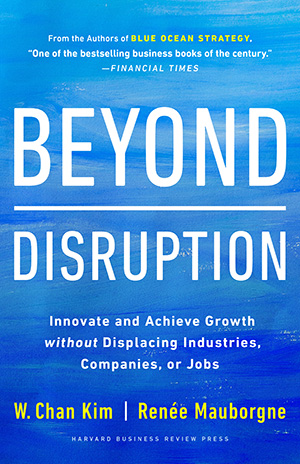
Late-career operators are structurally positioned for nondisruptive creation in a way younger founders aren't:
Your salary is the runway. Most twenty-eight-year-old founders don't have that.
Your accumulated expertise is the innovation input — pattern recognition built over thirty years of being in the room.
Your network is built. You don't need to spend two years cold-emailing.
Your reputation precedes you. Not as a founder. As somebody who's been around the work.
Reframe "don't quit your day job" from timid advice to the correct innovation strategy for your situation. Your day job is the funding round. You already raised it.
The Cheapest Innovation Toolkit in History
The frameworks are free.
Doblin's Ten Types of Innovation — free, in the open, with case studies and worksheets on Deloitte's site. Business Model Canvas — Alex Osterwalder gave it away two decades ago. Lean Startup — Eric Ries wrote the book and the methodology is everywhere. Customer development — Steve Blank teaches it for free in Stanford lectures on YouTube.
When EnergyXchain won our initial National Science Foundation grant, their first instruction was to stop writing code, fill out our Business Model Canvas and talk to 50 potential customers. Even though we had a key partner/customer, that exercise changed the direction of our company.
The tools are basically free too.
AI for prototyping — twenty bucks a month gets you Claude or ChatGPT capable of work that required a senior consultant two years ago. No-code for building — Bubble, Webflow, Glide, all under a hundred a month. Newsletter platforms for testing demand — Beehiiv, Substack, free tiers everywhere. Landing pages on Gumroad, Stan, Carrd. LinkedIn for distribution. Zoom for customer interviews.
When I built the Vialogix usability lab in 1997, the one-way mirror alone cost more than what an entire modern toolkit costs today. That simple lab required a dedicated room, scheduled sessions, computer, video recording equipment, and an employee salary for the facilitator. In 2026 you can run a discovery interview over Zoom in your kitchen on a Tuesday night, transcribe it with Claude in seconds, and surface the friction patterns by Wednesday morning.
It has never been easier or cheaper to innovate.
The constraint isn't cost. It isn't access. It isn't even time. The constraint is whether you'll actually use the tools, on a problem you actually understand, with customers you actually know.
That's the part AI can't help you with.
The Process, Sized for One Person
Here's the five-step version of what used to cost a 12-person team and a six-month engagement. Compressed for a solo operator with a day job and a Saturday morning.
1. Pick a customer you actually know. Not "the market." A specific person, or a specific archetype, whose work or life you understand because you spent decades near it. Your unfair advantage is not your idea — it's that you can spot friction in this customer's day that nobody outside the industry would notice.
2. Talk to five of them. Not a survey. Conversations. Forty-five minutes each, on Zoom. You're not pitching anything. You're listening for the moment they sigh, the moment they say "yeah, I just deal with that," the moment they describe the workaround they've built themselves. That's where the friction lives. Five conversations beats a hundred-person survey every single time.
3. Sketch the offer on one page. Use the Business Model Canvas if it helps you. Use a napkin if it doesn't. The point is the structure — what are you offering, to whom, through what channel, for what price, supported by what activities — not the artifact. AI is genuinely useful here as a sparring partner. Show it your draft. Ask where it's weak.
4. Run it through Doblin's Ten Types. Which types are you actually playing? If you're only playing Product Performance — "my thing is better than their thing" — you're in the least valuable silo of innovation. Look for ways to broaden the offer. Could you add a Service layer? A Channel innovation? A Profit Model twist? Three or four types working together is what Keeley calls "playing the chord." A single note is a hobby. A chord is a business.
5. Ship the smallest version that earns real feedback. A landing page. A LinkedIn post. A Beehiiv issue. A Gumroad landing page. The goal is not to sell — yet. The goal is to put something in front of real humans and watch what they do. Do they sign up? Forward it? Reply? Or scroll past?
Iterate. Then ship again. Then iterate.
That's the whole loop. It's not magic. It's just discipline applied to a problem you actually understand.
The Saturday Morning Test
Here's a real example.
You're a 58-year-old corporate procurement lead. You've spent twenty-two years watching mid-size manufacturers struggle to vet new suppliers — endless RFPs, opaque pricing, vendors who oversell and underdeliver. You know exactly where the friction is. You've built workarounds. You've trained three junior buyers in the patterns you spotted that the textbooks don't teach.
This Saturday morning, between coffee and lunch, you can:
Email five procurement peers asking for thirty minutes next week to talk about supplier vetting
Open Claude and sketch the structure of a Notion template that codifies your vetting checklist
Spin up a Gumroad landing page offering it for $99 with a one-paragraph description
Post about it on LinkedIn — not a sales pitch, just "I've been thinking about why supplier vetting is so broken, here's what I think and here's a tool I'm building"
Go mow the lawn
By next Saturday, you'll know if anybody cares. If they do, you iterate. If they don't, you ran the loop for the cost of a Saturday morning and a Claude subscription, and you learned something nobody can take from you.
The Bozos are still in their workshop sitting in Herman Miller chairs. You've already launched.
The playing field doesn't favor them anymore. It favors you. Use it.
Now go launch something 🚀
No business plan survives first contact with customers.

Modern Tools
I’ve used many email platforms over the past few decades, including things like HubSpot, Marketo, Constant Contact and Campaign Monitor. My middle son Clay introduced me to Beehiiv 🐝.
If your business will send newsletters, I can’t recommend it strongly enough.
They’ve made it drag-and-drop easy
They have built-in design tools
They have a very good recommendation engine for other newsletters
Their Advertiser network is robust and growing
They continue to add features to improve your newsletter business
Each week I get suggestions of companies who want to boost or sponsor my newsletter. I simply choose the ones I think will make the most sense for this audience.
Everything is automated: scheduling, distribution, payments, sponsorships, recommendation engine - all integrated with easy-to-use tools. And of course you can launch for free.
Ready to get started?
Click on the logo below to save 20% off your first 3 months of a paid plan after a complimentary 30-day trial.

Summer's here. Larry handles calls, jobs, and memberships automatically.

HVAC owners running 3–15 trucks are juggling calls they can't answer, membership lists they can't work, and software that doesn't connect. Larry fixes all of it.
Larry is Podium's AI employee for HVAC. He answers every call and books the job directly onto your dispatch board, 24/7. When your comfort club members are due for a tune-up, he texts them, books the visit, and follows up automatically. Your techs close estimates and collect payment from the field.
Air Design booked 13 extra appointments in their first 30 days.
Arctic Air grew revenue 30% year over year. Premier Heating & Air tripled lead conversion.
One system. One flat monthly fee. Built for HVAC businesses your size.
Recommendations
🤖 AI Report : 400,000+ business leaders (and teams at IBM, AWS & Zapier) start their day with The AI Report. 5 minutes. Plain English. No hype.
📕 MGMT Playbook : Practical management insights straight to your inbox every Wednesday.
🔖 The StartUp Marketing Newsletter : Your cheat sheet for marketing news, insights & tips tailored for the startup space.
🗃 Dealroom Business Success Uncovered : Learn directly from billionaire entrepreneurs on how to grow a business. Join a community of 2,000+ innovators.
Visual Crapshoot

Help me help you: What's the #1 challenge holding back your late career side hustle?
- Financial risk management - can't bet retirement
- Worry that you're not tech savvy enough
- Have connections but unsure how to use them
- Business model selection confusion
- Time management with family obligations
- How to validate product while still employed
- Age discrimination concerns
- Is it too late for my idea?
- Other
Launch Key readers – thank you for your support and feedback. I appreciate each and every one of you as I work to build something you value.
Remember, if there's anything you'd like to share — a recommendation, a story idea, or just a note to say hi, hit the reply button and fire away.
