
In partnership with

Welcome back to the Launch Key 🚀
This week is a little different. No business idea to take apart, no numbers to run. Just one unfashionable idea I've watched win for thirty-plus years.
And I can already hear younger subscribers with their ‘ok Boomer’ refrain, but patience is more than a virtue.
Let's get into it.
Gmail users may wish to read online since some parts may be clipped.
Comment below or answer this weeks poll and help improve this newsletter.
Table of Contents
Pull To Eject
Nothing ever happens as fast as you think it will.
Deals take longer to close. Products take longer to launch. The right hire takes longer to find. In my experience, most things that matter take years to play out. Rarely less.
That's not a popular message right now. AI promises you a new business by Friday, and every feed is full of people who apparently built one. But I've been around long enough to notice a pattern. The people who win over a career aren't necessarily the fastest. They're the ones who picked something worth being patient about.
The guys with no core
I was talking with a friend earlier this year about the sales guys we've both known over the years. First they were in banking. Then the internet. Then mortgages. Then tech consulting again.
Every move made sense at the time. Each one followed the money. But add them up and there's nothing there. Nothing compounded. No reputation that traveled with them. They changed with the times instead of standing for something.
You can't be patient about something you don't believe in. Patience without conviction is just waiting.
The numbers back it up
This isn't just an old guy's hunch. McKinsey tracked hundreds of large U.S. companies from 2001 to 2014 and sorted them by how they actually behaved: did they invest for the long term or manage to the next quarter? The long-term companies grew revenue 47% more than everyone else, earnings 36% more and economic profit 81% more. Their revenue also swung less along the way. (McKinsey report)
The part I like best: about one in seven of those companies didn't start out long-term. They switched partway through, and it paid off.
If that works for companies answering to Wall Street every 90 days, it works for a one-person business that answers to nobody.
What I stood for
I've loved new technology ever since HyperCard. That hasn't changed. But early on I understood that the tech was only ever the tool, never the whole story. From laserdisks to CD-ROM to the internet and mobile to blockchain and AI, the tech story has always been about what it allowed people to do.
Being able to explain that, in simple language, to the people who signed the checks turned out to be the thing I was good at. It got me into consulting. Then it became the foundation of businesses of my own. And it's why I give ideas away in this newsletter every Tuesday. Same conviction, just more grey hair.
A year to sell one client
In the late 90s I looked at our client list and realized something uncomfortable. Nearly all of our projects came from banking or finance.
Then the banks started laying people off. Not deadwood, either. Really good employees. That was my wake-up call. If banks could cut talented people that quickly, they could cut a vendor like us faster.
So we went looking for a second industry. Healthcare at the time was years behind banking in using online tools, which meant it needed exactly what we did. It also meant nobody was in a hurry to buy it.
It took a full year to sell Novant Health on our services. A year of meetings, follow-ups and patience I didn't always feel. But that one client grew our revenue and allowed us to sell other healthcare clients. It gave us a more diversified portfolio of clients. And the healthcare knowledge became more valuable as Empowered Benefits started to grow. And it was important at teaching me how to sell into other vertical markets.
If I'd treated healthcare like a quarterly sales target, I'd have quit too soon.
Thirty years of reputation
The other thing patience buys you is relationships that compound.
In the 1990s Gary Frey knew us for two things: quality code, and doing usability work before anyone else in Charlotte was. He recommended us because of it. Over the years we worked with some of the same clients. He gave me a ticket to a local blockchain conference. That turned into a new business, National Science Foundation grants and 3 patents.
Years later, Gary became one of the first career portfolio stories I wrote about here. He invited me on his Anything but Typical podcast. And earlier this year he invited me to join the AI panel at his CEO Convergence.
None of that was planned. You can't plan it. You just treat business relationships like they'll last a lifetime, and some of them do.
Even Steve Jobs had to wait
Everyone quotes Jobs' 2005 Stanford speech about getting fired from Apple being the best thing that ever happened to him. Fewer people remember what the twelve years in between actually looked like.
He was 30 when he left Apple and 42 when he came back. His new company, NeXT, launched a $6,500 computer that sold around 100 units its first month. He kept telling his team they'd sell tens of thousands. Meanwhile he'd bought a small animation studio called Pixar for $5 million, and Hollywood thought it was a joke.
Pixar's IPO made him a billionaire in 1995. The NeXT software became the foundation of Apple's operating systems for the next thirty years. But for most of his exile, patience wasn't serene. It was expensive, public and humiliating.
That's the part worth remembering. Patience doesn't feel like a strategy while you're in it. It feels like being wrong.
The play
If you're thinking about your next act, here's the advice I give everyone who asks me about consulting:
Pick something you can stay passionate about for two or three years. Not what's hot right now. Something you actually believe in, where other people are looking for the same answers you have.
Then give it the time it needs. And treat everyone you meet along the way like you'll know them for thirty years.
What do you stand for?
Now go launch something 🚀
Adopt the pace of nature: her secret is patience.
The AI notetaker that gets the hard words right

Your AI is only as good as what you feed it. Feed it a transcript with your product names, acronyms, and numbers spelled wrong, and you spend the afternoon hand-fixing the output.
Wispr Flow Notetaker uses your dictionary and calendar, so product names, acronyms, numbers, and uncommon names come out spelled right. It pops up when your meeting starts and captures Zoom, Google Meet, Teams, and Slack huddles with one click, no bot joining the call.
Then your meetings show up inside Claude or ChatGPT through the built-in connector. No copy paste. Try Notetaker free on Mac and Windows.
Old School Wisdom
The Lessons of History — Will and Ariel Durant (1968)
The Durants spent four decades writing The Story of Civilization, eleven volumes published between 1935 and 1975. After the tenth volume, which won the 1968 Pulitzer, they stopped to ask what all of it actually taught. The answer was a book of about 100 pages. They admitted that trying to "compress a hundred centuries into a hundred pages" was a risky thing to do, then did it anyway. Will Durant was 82 when it came out.
That's patience you can hold in one hand. Forty years of reading became an afternoon's worth of conclusions, and those conclusions are still in print. David Senra covers it in Founders #342 if you'd rather listen.

Modern Tools
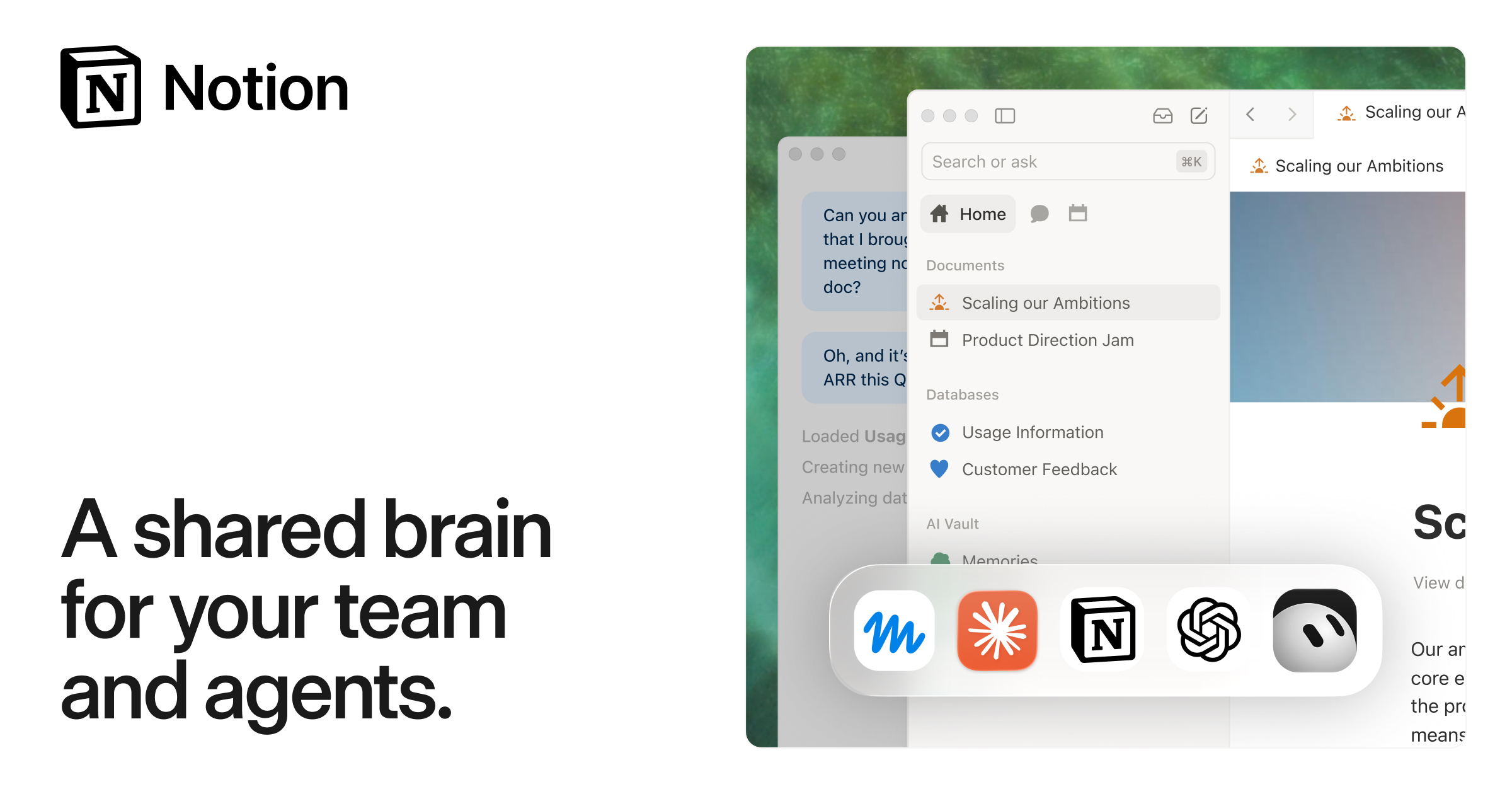
Notion + Claude
People ask what tech I’m using to publish every Tuesday. Here's the actual machinery.
Capture. Everything starts in Notion, in two linked databases. The Newsletter Pipeline holds every issue idea as a page, moving through five stages: Seed, Developing, Drafting, Editing, Published. The Knowledge Base holds what I read and listen to. Each book or podcast gets a structured summary: core thesis, key figures, themes, a few quotes, the critics' view, and a list of questions the entry should be able to answer later.
Connect. When a Knowledge Base entry supports an idea, the two get linked. Claude works inside my Notion through Notion's connector, so when I add a book it checks the summary against every open idea in the Pipeline and suggests links. Strong ideas collect evidence. Weak ones sit there alone, which tells me something too.
Discover. Every Sunday a small research agent on a Mac Mini scans seven subreddits for questions people in our situation are actually asking. It checks those topics against Google search suggestions and has Claude rank them. Now a Grok research agent does similar work. The best three to five land in my Notion Inbox.
Draft. When an idea is ready, Claude reads the seed and everything linked to it. Then it asks me for the parts only I have. It can't supply the stories. The Novant sale and Gary Frey in this issue came from me. Once I’m happy with the draft, Claude builds the issue in Beehiiv, and I do final edits, choose advertisers and schedule.
This issue is a good example. "Patience" sat as a seed for three months while six books and podcasts attached themselves to it. The system was patient so I didn't have to be.
Free Knowledge
Founders #365: Nick Sleep's Letters — David Senra
Senra walks through thirteen years of investment letters from Nick Sleep, who made patience an explicit strategy and wrote it down as it happened. A good road-trip listen.

Recommendations
🚏 The Cautionary : Learn to challenge conventional wisdom.
📕 MGMT Playbook : Practical management insights straight to your inbox every Wednesday.
🏢 Retirepreneur : Your guide to turning decades of experience into profitable consulting, coaching, or course businesses, without risking your retirement security.
🗃 Dealroom Business Success Uncovered : Learn directly from billionaire entrepreneurs on how to grow a business. Join a community of 2,000+ innovators.
🧾 Redefining Retirement : Too Young to Retire, Too Old To Take Orders? Yeah, Me Too.
Visual Crapshoot

What should year 4 of The Launch Key do more of?
Launch Key readers – thank you for your support and feedback. I appreciate each and every one of you as I work to build something you value.
Remember, if there's anything you'd like to share — a recommendation, a story idea, or just a note to say hi, hit the reply button and fire away.

